001: Silt and Soil
(2025 Weeks 1-3)
“You know about liquefaction, right?”
The man’s question cut through my earbuds and stopped whatever thoughts I had in their tracks. I fumbled around to pause the music while he continued.
“It’s that phenomenon where sand starts acting like a liquid during an earthquake. All the buildings around the Pacific Ocean have to deal with it.”
“Um… what?”
I had no clue why this dude had chosen to bombard me with some geology lesson in the middle of an airport, but I figured I’d humor him.
“Yeah, I know about liquefaction. It was part of the New Madrid earthquake back in 1812.”
“Right!”
“So… why are we talking about that right now?”
“Well, I’m a structural engineer, and I was just reading about a building collapse in Chile that might be linked to the phenomenon.”
I guess I looked Chilean to this guy. I suppose that’s a fair enough guess as to where I might be from; I look like I belong everywhere and nowhere, and often feel the same way.
“Oh, well I’m not from Chile.”
“Uh, I’m sorry. I mistook that sticker on your bag for Santiago.”
He gestured awkwardly to a white oval sticker on the side of my carry-on that read “SAN” in black capital Helvetica letters. A reference to San Diego, not Santiago.
“It’s all good. Where are you heading?”
So, at least for this layover, I figured I’d be passing the time with this guy. It seemed like a pleasant way to spend the next hour and half. If nothing else, it would probably be more engaging than listening to that PUP album again. And over the next hour, I got to know Mr. Cameron Baker, who thinks himself to be the next Frank Lloyd Wright of department stores. If his approach to planning buildings is anything like his approach to hitting up strangers for small talk, then I can’t wait to see him construct the next Centre Pompidou on behalf of JCPenney.
I probably learned more about Cameron over that hour than anyone I’d met so far in Philadelphia, and it genuinely disappointed me when he told me he was flying out the other way after our chat. He was on his way back home, too, only he was getting back to Minneapolis.
“That’s certainly a change of pace from Phoenix,” I responded, after he told me his final destination.
“What can I say? I like the heat of the desert.”
“You can have it. I grew up in it and I’ve had enough of it for a lifetime.”
“Are you nuts, dude?” Cameron looked at me as if I’d just told him I planned on grabbing lunch out of a nearby trashcan. “You really prefer the snow and the cold? I could never live in Minnesota again, I can’t believe anyone would.”
“Well, Philadelphia isn’t quite that intense. I don’t think it’ll be, at least.”
“Y’know what I love most about the desert?”
I braced for what Cameron would say next. He’s a nice guy, but his outlook on the world is so much more driven than my own. The man loves his job, I can say that with several degrees of confidence, but I couldn’t ever bring such a technical outlook onto the rest of the world if I worked with it day in and day out.
“What?”
“It looks empty, but it’s so full.”
“Yeah?” I wondered where this was heading.
“Y’know the Indians lived all through the desert, man?” His eyes lit up in a way that I hadn’t expected. “They were able to fill up all that vastness with life. They build their homes in the cliffs and actually lived by the cycle of the earth.”
“I’ve gotta admit, Cameron, I didn’t expect that to be the appeal for you.”
My sass didn’t seem to land like I thought I would, because Cameron seemed to just dismiss it and continued explaining.
“My aunt and uncle lived in a city called Farmington, up near the Four Corners,” he said. “Whenever we visited them, they took us to see the Pueblo cave dwellings and all the historic sites that have been preserved up there. I remember walking into one of the caves they carved out and thinking about how they must have done that. The tools they used, the way they picked the cliff, the reason I saw the sun perfectly setting through the window.”
He had my complete attention now. I nodded to him to keep going.
“That’s when I decided I wanted to build things for a living. I wanted to make living possible in the places that no one would expect.”
“Wow.” I couldn’t really say more than that. Maybe I’m not the best at reading people, but even I was surprised at how off base I was. Being out on the East Coast might be doing things to my cynicism levels.
I collected thoughts and started to respond.
“That’s a really wonderful story,” I started. “I really appreciate you sharing that with me. Especially since my mom is from Farmington.”
“No shit, really?” Cameron was ecstatic. He pounced on that factoid like a hungry fish seeing a worm drop down from the dry heavens.
“Yup. I’ve never been myself, though.”
“Man, you’ve gotta get up there. The Southwest must be one of the most magical places on earth.”
“Don’t I know it.” I huffed and it came out as some awful mixture of a scoff and a cough. I hadn’t meant to sound sick.
“What do you mean?”
“Well, I’m from the Southwest. I’m from El Paso.”
Cameron nodded, but whatever spark he had was extinguished.
“I’ve driven through El Paso,” he said, trying to kindle some connection to my far-flung hometown. “It looks like a cool place! The hotel I stayed at was pretty nice.”
“Well, we’re nothing if not hospitable!” I replied. “We’ve always been a place to pass through, I suppose. Few people really stay.”
“Is that so bad?” Cameron asked? “Doesn’t that mean you get to keep the best of it for yourself?”
Huh. There he goes again, this strange man catching me off guard.
“Like, look,” he started again, “I’m living in Phoenix and I can’t even tell that there were people who lived there already. The whole city is made up of people who came from somewhere else. It’s not like Minneapolis, where you feel the city. It’s all a hodgepodge of different people’s Americas.”
“I guess you’ve got a point.” I conceded that he was making a lot of sense.
“If there’s one thing about home I miss, it’s that sense of place.” Cameron looked a little more enthusiastic. “I’m eager to feel that again.”
“I’m sure Christmas in Minnesota is a special thing,” I said, trying to douse my words in sincerity. “Even if I don’t celebrate the holiday, it really lends itself to that part of the world.”
Cameron’s eyes lit up again, like he was 10 years old again. “It’s hard to not get romantic about it. The lights, the people, the whole atmosphere is something special.”
“It sounds like you’re gonna have a great time,” I said, “as long as you get on the plane.” I gestured at the gate agent picking up a microphone.
“Flight 1835 to Minneapolis is now boarding out of Gate C37.” Her accented voice sat atop the hum of the concourse and slowly sank into it, moving people like grains of sand, settling into their places at the gate.
Cameron hopped up and grabbed his coat and satchel, all in one fluid motion that belied a lifetime of practice putting on bulky layers. He had a little spring in his step that betrayed what he said next.
“It’ll be nice to get back home. If I never have to put on a coat again, it’ll be too soon.”
“So much for looking forward to Minnesota, huh?”
He laughed. For a guy who strikes up conversations with strangers, he was surprisingly unamused by most of what I had to say. The tenor of our layover was a bit more wistful, drifting between our mutual frustrations of the past year and the fading gleam of the twinkling lights from the awnings of our childhood homes.
“Take care, Nick,” Cameron said while extending a hand. “Make the most of your trip home. And make sure the structural engineers out in El Paso aren’t cutting their corners.”
“Only if you can make sure that every insurance company’s buildings are found unsafe for occupancy.”
And with a smile and a firm shake of his right hand, he was off to join the throng of people filing into the wrong line at the gate. It’d been a long time since I was able to chat with someone so openly, and a stranger at that. I guess the nature of an airport lent itself to that kind of connection. With his stories swirling in my head, I pushed play on my iPod and started to sift through all the silt he’d stirred up.
Before long, my own gate agent was calling, putting out the signal to get on the plane lest the holidays be ruined by my absence. The time came to queue, walk down the jetway, and make a little home in the seat for the flight across the state, from one home to the other.
Taking off over Dallas can be frustrating. Not for any reasons related to the actual conditions of flying, but rather, the scenery. The sprawl. The seemingly unending creep of society further and further into the margins of prairie. The airport’s position in the middle of the aptly-named Metroplex really makes it clear how vast the streets are that people call home around here. It’s hard to imagine how it’s habitable, even for someone who spent almost 10 years calling this exact place home. Maybe that’s just the Philly rubbing off on me, but I’ve always been fascinated by what exactly makes people romanticize these places.
Of course, from the sky, all the houses might as well be stones on the bed of a river; slowly worn down by the atmosphere and the flow of time, they smooth out and get set in, while new ones are deposited on the fringes of the bed. Whatever formerly made them unique is slowly picked up and taken elsewhere, until the stone’s just one of hundreds, no longer defined by itself, but by where it is. All its neighbors. And I, just a grain of silt, flowing back home, passing by from above.
My thoughts turned back to my destination. El Paso’s a weird place. It’s isolated. Deeply isolated. And just like every weird uncle that pops up at family reunions, we could probably stand to be a little more connected to the rest of society. But just like the dude prattling on about the evils of NATO and the ploys of corporate America, he wouldn’t be the same if he dropped it all to talk about the weeknight news or how much the Cowboys suck. We’re the weird relative the rest of Texas can’t get rid of, no matter how little we fit in with the rest of the state. With the rest of the world, even. I guess that’s part of why Dallas was never the place where I’d settle. It was too foreign to me, too rooted in its own simultaneous homogeneity and resentment. It’s hard to find community in a place that sees HOAs as reasonable and sound neighborhood activism, and then goes on Reddit to complain about it.
That’s not to paint with a broad brush. I found the people who saw how weird that outlook was and we bonded. We were all just kids from the suburbs of somewhere, coming together to chart our next courses through a world that would steadily start devolving into chaos. Maybe that’s why the thought of a suburban riverbed feels weirdly comforting nowadays, especially after the stream of life picks you up and takes you places and shows you things you’d never have dreamed of seeing.
Certainly falling in love wasn’t part of whatever life I’d imagined I’d have when I moved out to Dallas. Even the idea of finishing school, ostensibly the whole reason I was moving, was sufficiently obtuse enough to remain out of focus for years, until one day, a diploma was sitting in my hands. Creating a life out of that one initial decision to come to Dallas was something that I never consciously decided, it just started to happen, in the way that I assume most people’s lives start coming together when they’re still teenagers, or even younger. I’m stuck assuming, of course, because I never got to actually make conscious decisions while I was a teenager, while I was actually in El Paso. My story had already been written for me over those years, whether I wanted it to be or not.
And so when I got to experience the world-rupturing emotions that often come in high school, that create a sense of connection, I started becoming moored to Dallas rather than El Paso, the place that feels like such a natural home to me. I think that I started to relate myself to my home more the more that Dallas started feeling like home, probably in some desperate attempt to reconnect myself the only home that I’ll ever have. It kinda worked, too. The brief trips back out west took on a greater importance, not just for the destination, but for the journey itself; I don’t think a nine-hour solo roadtrip across one of the most desolate parts of the country can’t not change someone, in a way.
Crossing the desert, crossing the mountains, it’s not just how I had to go home, it’s how I had to go inside myself and find the person I was who was stuck. The kid whose story was written for him; it was time to hand him a pen. And what he’s writing now, well, it shows a lot of growth.
Nothing can uproot parts of me from Dallas. There’ll never be another Office Depot where I parked my car and kissed a boy in the back seat for the first time. There’ll never be another university like UTD where I walked through the campus and felt a sense of freedom for the first time. Where I woke up next to someone for the first time, comfortably in their embrace. Where I accidentally went viral online for about two weeks. Where I found a little hiding spot in the back stairwell of a building and sat for hours, reading, writing, listening to music, and observing, one semester after another.
There’ll never be another little snack shop where the owners know my name, where I’ve stumbled in year after year all because of a well-timed Google Maps search on a day in May. There’ll never be another first apartment, backed up against a golf course and wedged in next to a fire station, letting me hear the dispatches when the afternoon slowed to a silent pitch. There’ll never be a synagogue, built and designed like none before it, whose sanctuary feels as sacred and where my faith finally began to find me. There’ll never be another suburban park, thick with carefully planned suburban forest, where I can share a first kiss with the love of that life.
Dallas is home. It was home. It’ll always be home because of all of those things. But El Paso is home, too. I couldn’t have come from anywhere else.
That kid I came back for is the only one who saw the things we saw. He remembers the booming horn of a train, crossing over the street on a bridge, cutting through the night and pausing the baseball game as it rattled on the tracks on the berm just past the right field wall. Everyone stopped while the mammoth locomotive pulled its load down the tracks and eventually past our little game, off to wherever, like so many of the vehicles passing through El Paso.
He’s the one whose mom sent him off with a big hug and a smile as he went into the old Plaza Theater, quaking with nerves before sitting to play in the city’s youth orchestra in front of a packed house. I’m not judging him anymore by the standards of my adult hindsight; it doesn’t matter how much or how little he practiced, how distracted he was by the minutiae of exactly the kind of suburban life he felt didn’t applied to him, how much he was hurting inside and had no way to let it out. No, none of that matters anymore. Because that kid was still good enough to earn that spot and brave enough to take his seat on the stage and play his instrument. And maybe it wasn’t the right instrument forever, but on that night, it was.
He’s the one who could see the sun paint the sky psychedelic shades of teal, orange, pink, and purple on any given day, and just marvel at it. Watching the sky do its chromatic dance in the corner of his eyes while he focused on speeding down the slight incline of the driveway towards the empty street. He dragged his father out there to watch, but the old man loved every minute of it; why else would he cheer the kid on and tell him he was approaching near-racecar speeds when he was maybe going 10 miles per hour, at most, if not for love? Why would that night stick in that kid’s memory if not for love? Why would the place where this kid’s life was torn apart and hastily stitched over, with scraps from all over, not ultimately be the place that feels like home if not for love?
That kid’s home is El Paso. Our home is El Paso. And it’s Dallas, too.
The funniest thing about leaving these shreds of memories scattered across the suburban landscape like confetti the wind stole from a party is that they bring magic to the most unremarkable places. There’s no good reason that an office supply store or a neglected baseball field should feel so incandescent with meaning, with nostalgia, and yet, these places – the ones that are so often overlooked and treated with the least consideration – are full of that magic. They’re full of that love. And that’s why we come back, no matter the hassle, no matter the effort, no matter the layers upon layers of clothing that are donned and doffed in the process, we go home because we find love there.
Suppose it’s fitting that now my home is the City of Brotherly Love.
“Did you happen to catch that?” The sleep fell out of my mouth with the words as I muttered to my seat mate. “Are we delayed?”
“Oh, no. We’re about to prepare for landing,” she said. “You didn’t miss much.”
“Ah, thanks. I hope I was a graceful sleeper.”
“You were the perfect seat mate,” she replied, allaying the worst of my fears.
“Glad to hear.” I chuckled a bit as the words came out and turned my attention back to the window of the plane.
To tell the truth, I wasn’t even sure if I had slept. After a while of listening to music, taking off from Dallas, and zoning into the little vibrations from the plane’s engines, I knew I drifted off, but wasn’t sure where the flow had taken me.
“Are you from El Paso?” The woman next to me seemed to hesitate before getting the words out, but decided to reach out anyway.
“Yeah, I am.” I tried to lay as much reassurance onto the sentence as I could. “I live in Philadelphia now, but El Paso’s home.”
“Oh, that’s nice! I’m coming home, too. I grew up here but now I live in San Antonio.” She seemed relieved, thankfully.
“What took you out there?”
“Family,” she said. “My mom’s uncle needed a lot of care before he passed, and he didn’t have any kids of his own. Our family took care of him.”
“That’s so kind,” I responded. I had wanted to say more, but couldn’t. “How long ago did you leave?”
“Oh, when I was young,” she said. “Maybe when I was 10? It’s hard to remember.”
“I can imagine such a sudden change wouldn’t be the most pleasant memory.” I suddenly felt very grateful that my family’s stint as caregivers only cost us a bedroom, not a move across the state.
“Yeah, it was a tough few years.” The woman let out a breath she didn’t seem to know she’d been holding. “But we got through it. We’re all coming back to El Paso for the holiday.”
“That’s good! Why not go to San Antonio, though?”
“It’s not home.” The words came out like polite knives, as if the mere insinuation that San Antonio was home was an insult.
“The rest of my family moved back last year,” she said, “but I stayed in San Antonio to finish my degree. This is the first time we’ll all be together here since I was a kid. Even my brother got leave approved to come back from his post at Fort Campbell.”
“Well, cheers to that!” I grabbed the half-empty water bottle from the seat back pocket and pretend to cling it against her plastic cup that held the remnants of a soda and some ice. We shared a smile and sipped what little remained of our drinks. The liquid slid over my chapped lips and down my dry throat; for all its perks, El Paso makes its visitors pay in humidifiers and lip balm.
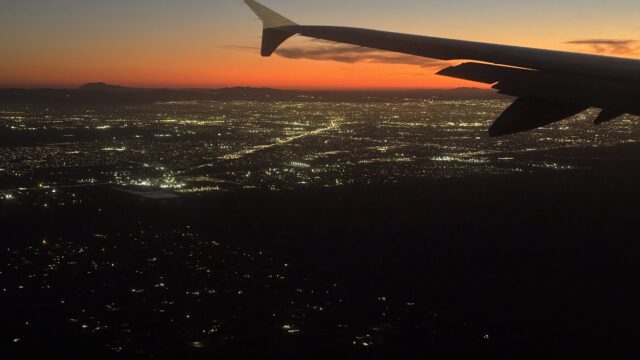
“I’ll never get tired of this view.” She gestured to the half-open window behind me, and I slid the cover back up into its pocket. The lights twinkled against the pitch black desert floor, growing and growing until they filled the horizon.
“I love it so much,” she said, softly.
“So do I.”
We chatted a little longer, and after the plane landed, she excitedly texted her family that she made it , safe and sound. I did the same, and as we taxied, I thought of what Cameron had said to me earlier in the day. The sands of El Paso needed work to become stable, my work. I needed to put in the effort to shape it and engineer it just right to where I could finally stand upon it. It took putting down roots on firmer ground first to finally be ready to fix the past.
I never realized that the sand could support me like it did now, just like it supports those thousands of twinkling lights. I never realized that love can even blossom in the desert. In the emptiness of the hot wastelands is where I find my home. In the city that rises from the dust is where my family will always be. From the sand I was and from the sand I will be, always.
This was inspired by the tracks “Coffee Eyes” and “Me vs. The Highway” by The Wonder Years, off of their sophomore album Suburbia, I’ve Given You All and Now I’m Nothing from 2012.
So I know that my goal was to write a piece every week, but uhh… that’s hard. And so it’s a little late, but I’m so excited to finally get this project underway! I’m genuinely really proud of this piece, and it came together in such a natural way. I was pleasantly surprised at what ultimately resulted, even if it did skew back towards the autobiographic. Let me know what you think.